

New research from American scientists is changing perceptions of the mass extinction of dinosaurs. It turns out that after the asteroid impact, Earth turned into a real “furnace,” where deadly heat was trapped by a gigantic cloud of dust.
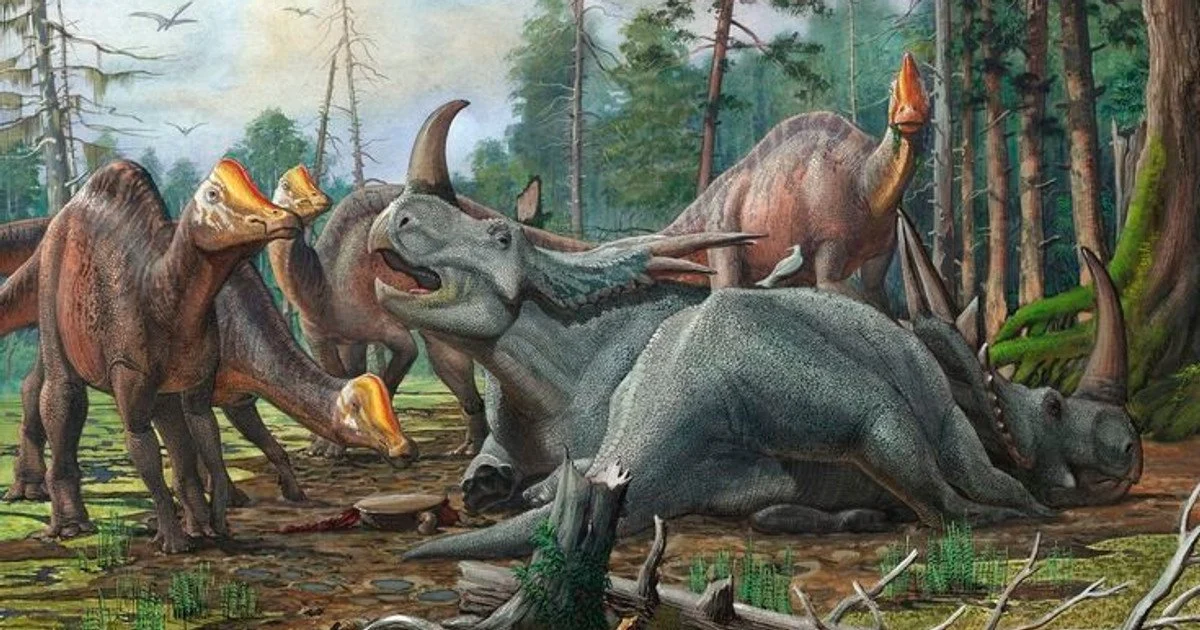
Як вимерли динозаври / © Pinterest
Dinosaurs perished in a hellish “furnace” created by a hot dust cloud after an asteroid struck Earth 66 million years ago. This conclusion was reached by scientists from Purdue University after studying the global consequences of that catastrophe. Thus, according to the researchers’ hypothesis, dinosaurs died from infernal temperatures and fire.
This is reported by The Telegraph.
Hell on Earth: Scientists Discover What Destroyed Dinosaurs After Asteroid Impact
When an object the size of Everest collided with planet Earth at a speed of about 72,000 km/h, it instantly vaporized everything in its path and caused fires within a radius of over 1400 kilometers. More than 1000 cubic kilometers of rock were thrown into the air.
Some of these condensed into tiny stone droplets – spherules, which began to fall en masse onto Earth. They further heated the atmosphere.
The primary cause of the mass extinction of dinosaurs was a giant layer of dust that acted like a lid on a pot: it tightly covered the planet and prevented thermal radiation from escaping into space.
“Anything that couldn’t somehow hide – underground or underwater – got baked or fried,” says atmospheric science expert, Dr. Alexandria Johnson.
After calculating the physical properties of the dust cloud, scientists discovered that it was almost impenetrable to heat. Surface animals received a dose of thermal radiation 17 times higher than a lethal dose for humans.
The temperature was so high that grass, needles, and moss ignited. The Earth was turning into a continuous scorched land.
Professor Brandon Johnson from the Department of Earth, Atmospheric, and Planetary Sciences at Purdue University explained that the dust cloud blocked heat radiation, causing the planet’s surface and everything on it to seem like they were roasting on coals. This is precisely what killed the dinosaurs and all other ancient animals.
Previously, it was believed that the main factors of extinction were tsunamis and prolonged cooling due to the blockage of sunlight. However, new data suggests that for most species, the apocalypse occurred much faster. Only avian dinosaurs, as well as animals that could hide underground or in water, managed to survive.
Evidence that molten rocks rained down on Earth had been found by scientists before – microscopic spherules were even found in the gills of fossilized fish. The current calculation has proven that it was this layer of dust that retained deadly heat near the surface for years.
Dinosaurs: Latest News
It is worth noting that scientists were long puzzled by the absence of aquatic or marine dinosaurs. The study of the skulls of spinosaurs – giant predators with dense bones, paddle-like tails, and fish-catching teeth, indicating their semi-aquatic lifestyle – helped solve this mystery.
Researchers discovered specific depressions and channels above the eye with a duct to the nostril in the skulls of later spinosaurid species. These correspond to the location of a salt gland, which, by analogy with modern marine birds and iguanas, allowed them to filter and excrete a dangerously excessive amount of salt from their bodies. This is a classic example of convergent evolution for survival while hunting in water.
Paleontologist Andrea Cau emphasized that these glands were hidden under the skin and did not alter the animal’s appearance, but they made it possible to connect bone structure with the dinosaur’s diet. The study authors conclude: most other dinosaurs never conquered the oceans due to the anatomical incompatibility of their skulls with similar salt-excreting systems.
Comments Sort: New Old Popular Send