

A deposit valued at up to $18 trillion has been discovered in one of the planet’s least explored regions.
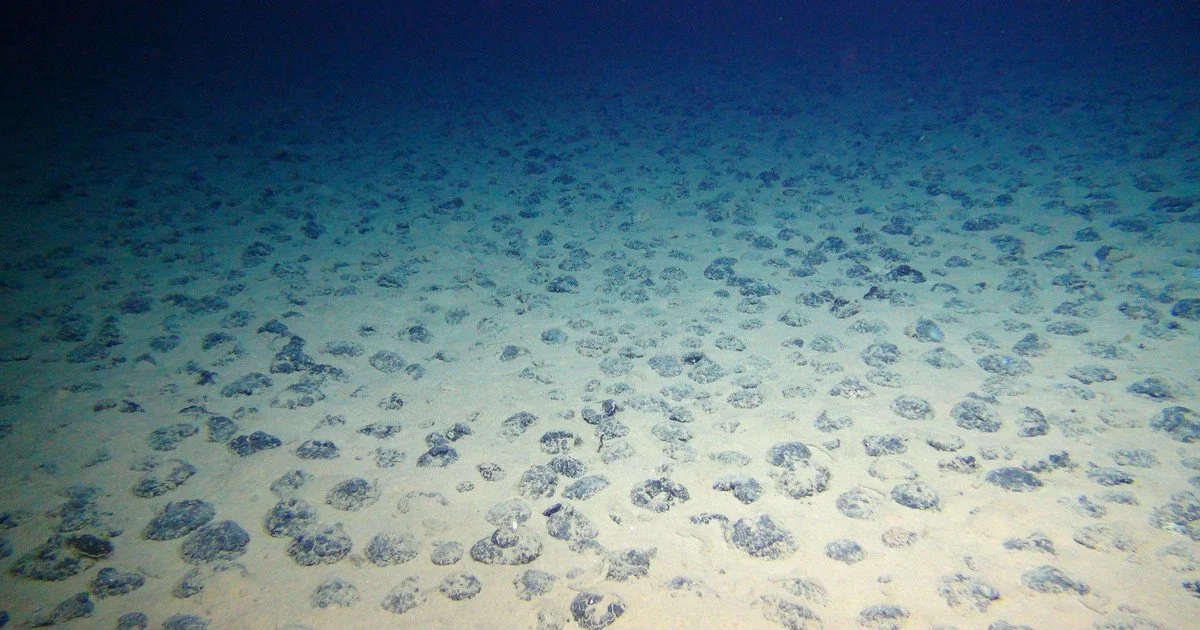
Polymetallic nodules. Photo: CC BY 4.0
On the floor of the Pacific Ocean, between Mexico and Hawaii, lies a vast deposit of polymetallic nodules – geological formations containing metals crucial for manufacturing batteries, electric vehicles, wind turbines, solar panels, and power grids. According to estimates by the U.S. Geological Survey, the Clarion-Clipperton Zone holds approximately 21.1 billion tons of these rocks, with a potential value reaching $18 trillion.
This was reported by the publication Liber Tatea.
The Clarion-Clipperton Zone spans roughly 6 million square kilometers. It is situated at an average depth of about 5000 meters. Polymetallic nodules rest on the surface of the ocean floor and range in size from an apple to a small potato.
Current estimates suggest these rocks contain nearly 6 billion tons of manganese, around 270 million tons of nickel, 230 million tons of copper, and approximately 50 million tons of cobalt. These are precisely the metals extensively used in the production of modern batteries and energy infrastructure.
As scientists explain, the nodules have formed over millions of years. Each one began to develop around a small fragment of a shell, bone, or hardened sediment. Over time, metals dissolved in ocean water gradually accumulated on it. The rate of this process is only a few millimeters per million years. Many of these formations are estimated to be between 2 and 10 million years old.
In addition to substantial metal reserves, the area captures scientists’ attention due to its biodiversity. A study involving the Natural History Museum in London identified 5578 animal species in the Clarion-Clipperton Zone. Of these, only 436 were officially described by science, while over 5000 species proved to be new to researchers.
In recent years, expeditions continue to discover previously unknown life forms in this region. Among them are new species of starfish, deep-sea crustaceans, and the novel superorder Mirabestiidae.
Researchers note that polymetallic nodules are not only a source of metals but also a vital component of the local habitat. Sponges, anemones, and other organisms attach to them, and some species depend on these formations for survival.
The results of scientific experiments are also used when assessing the potential impacts of extraction. One such experiment began in 1989 in the Peruvian Basin, where researchers simulated the effects of future mining on the ocean floor. A follow-up survey 26 years later revealed that signs of disturbance remained visible, and several communities of organisms had not fully recovered. Some studies also indicated only partial recovery of microbial communities.
The International Seabed Authority has been working for several years on regulations for mining in international waters, but a final commercial mining code has yet to be approved. Meanwhile, interest in the region continues to grow.
In 2025, the United States authorized federal agencies to issue licenses for deep-sea mineral exploration. China has also intensified its trials in the Clarion-Clipperton Zone. Previously, during test operations, the company Nauru Ocean Resources extracted over 3,000 tons of nodules from the NORI-D site.
Against this backdrop, at least 32 countries have called for a moratorium, a precautionary pause, or a delay in commercial deep-sea mining until science gathers more data on potential risks to ocean ecosystems. Among them are France, Germany, Brazil, Chile, Costa Rica, and a number of Pacific island nations.
As a reminder, scientists have been unable to solve the mystery of paleodictyon – a peculiar honeycomb-shaped deep-sea imprint found on Earth for 500 million years – for over 170 years.
Comments Sort: New Old Popular Send