

An archaeological revelation emerged during renovation works at a Thai temple, shedding new light on historical narratives. Beneath a Buddha statue, artifacts of gold, silver, and bronze had been preserved for over a millennium.
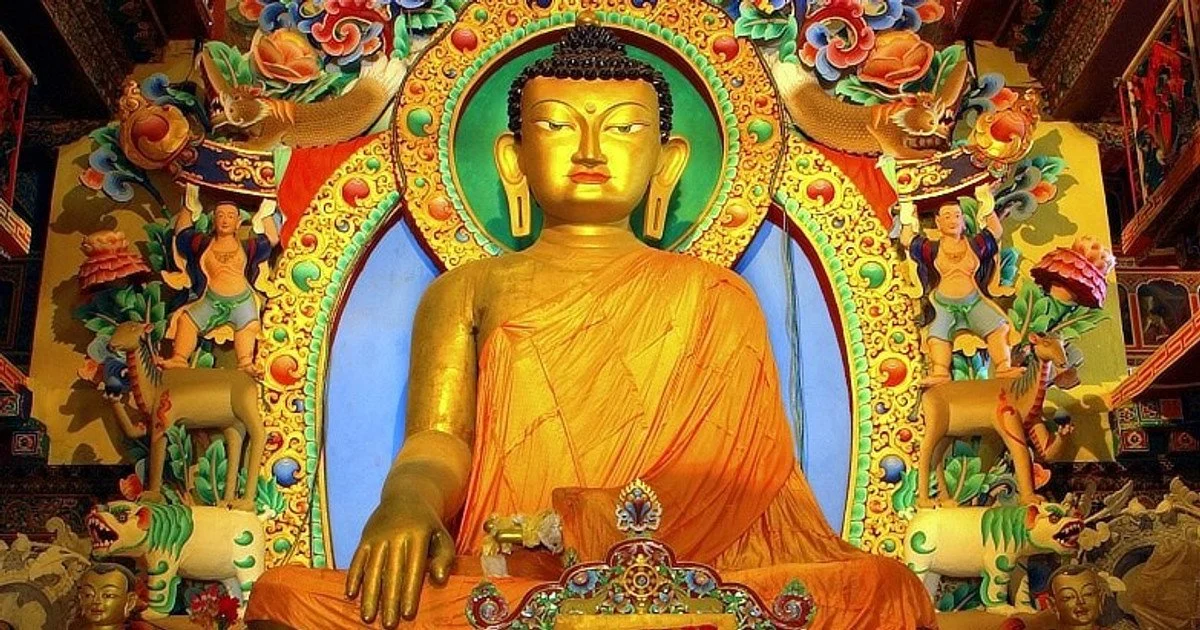
Buddha statue. Photo: Appaji/CC BY 2.0
During the repair of the drainage system in a temple in Thailand, workers unexpectedly discovered a treasure approximately 1300 years old beneath an ancient Buddha statue. Archaeologists unearthed dozens of gold, silver, and bronze artifacts, which preliminary assessments suggest belong to the Dvaravati period.
This discovery was reported by the publication Daily Galaxy.
The artifacts were found during conservation efforts at the Wat Thamachak Sema Ram temple complex, home to the Phra Non archaeological site – one of the oldest and longest reclining Buddha statues in Thailand. Researchers estimate the sandstone sculpture, measuring about 12 meters in length, dates back to approximately 657 AD.
While working on the drainage system, laborers dug over a meter deep and unearthed a ceramic vessel. Inside, 33 items made of gold, silver, and bronze were stored. Among the finds were gold rings, silver earrings, and bronze hoop earrings.
The Department of Fine Arts noted that the bronze ornaments’ characteristics align with Dvaravati period artifacts previously discovered in other parts of Thailand. Following this initial find, archaeologists expanded their excavation around the statue and uncovered three more groups of ancient objects.
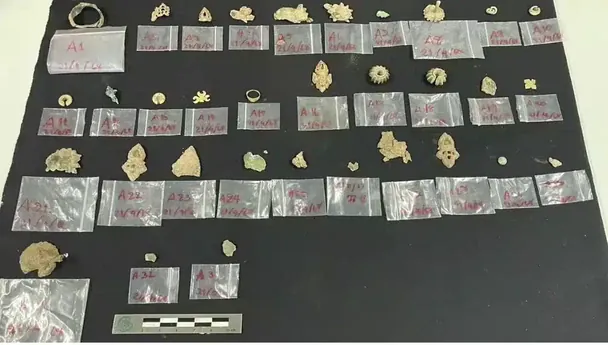
Treasure. Photo: Department of Fine Arts, Thailand.
One of the most valuable artifacts was a rectangular gold sheet featuring a relief image of Buddha in a preaching posture, crafted using the repoussé technique. The depiction shows Buddha with spiral curls, a large halo, elongated earlobes, and a robe covering one shoulder. A small hole in the upper right corner of the gold sheet, according to the Director-General of the Department of Fine Arts, Phanam Bott Chantrakot, may indicate that the artifact was hung or used as a decorative element.
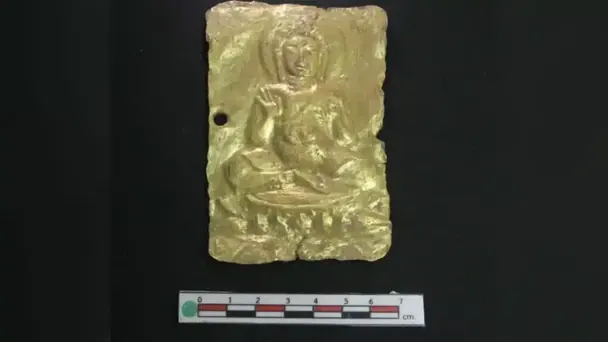
Gold relief plaque with Buddha image. Photo: Department of Fine Arts, Thailand.
Additionally, researchers found another decorative metal sheet made from a lead-tin alloy. It depicts Buddha standing within an arched frame, accompanied by two human figures. One of these figures is poorly preserved, while the other, according to archaeologists, could be a Thai representation of the Hindu deity Brahma.
Another significant find consisted of folded metal sheets concealed within compacted clay between layers of cement. Due to their damaged condition, specialists are currently unable to determine the exact number of artifacts or fully identify the images inscribed on them. Archaeologists are particularly intrigued by the placement of these objects behind the Buddha statue’s head.
As Phanam Bott Chantrakot explained, this positioning might suggest that the artifacts were left as a ritual offering during the construction or utilization of the shrine, in accordance with the religious customs of that era.
All discovered items have now been transferred to the Phimai National Museum. There, they are undergoing examination, documentation, cataloging, and preservation efforts for the fragile historical artifacts.
Recall that archaeologists discovered a stone road buried under silt at the bottom of the Adriatic Sea, which people used almost 7000 years ago. It led researchers to new details about a submerged Neolithic settlement near the island of Korčula.
Comments Sort: New Old Popular Send