

Thousands of giant stone jars in Laos have remained one of archaeology’s greatest enigmas for decades. New excavations have provided an answer.
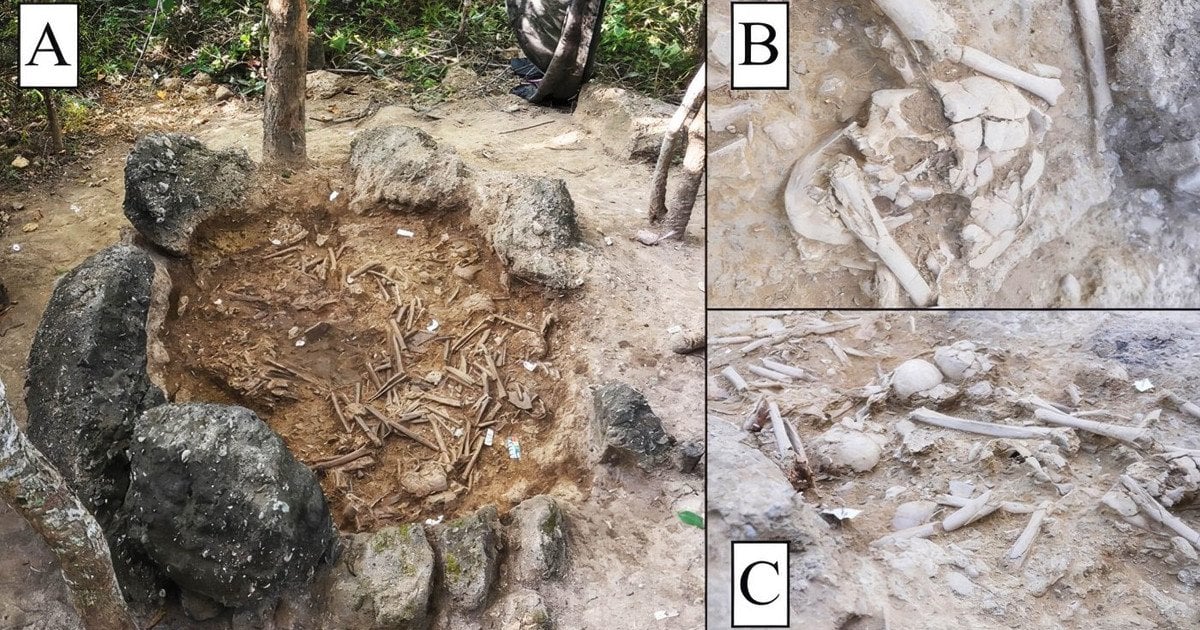
Bones in a jar. Photo: Cambridge University Press
Archaeologists have come closer to unraveling the mystery of the giant stone jars in Laos, whose purpose remained unknown for nearly a century. During the excavation of one of the largest jars, researchers discovered the remains of at least 37 individuals.
This was reported by Earth.com.
The excavations were conducted at site No. 75 in Xiangkhouang Province, approximately 70 kilometers northeast of the city of Phonsavan. This is where one of the region’s largest stone jars is located, with a diameter at its base of almost 2.1 meters.
Over three field seasons, a team led by archaeologist Nicholas Scopac from James Cook University (Australia) investigated the contents of this stone vessel. Instead of grain or water, as some early researchers had hypothesized, archaeologists found a jumble of human bones inside.
After detailed analysis, scientists concluded that at least 37 individuals were interred in the jar. The minimum number was determined by recurring body parts and teeth. Among the buried were children approximately 18 months old, adolescents, and adults.
Along with the human remains, researchers found an iron knife, a small bronze bell, fragments of pottery, and glass beads.
The arrangement of the bones particularly caught the scientists’ attention. Skulls were neatly placed along the jar’s walls, while long bones lay in separate clusters. Archaeologists believe this structure could not have formed by chance and indicates the performance of a burial ritual.
The condition of the remains also supports this theory. The bones were dry and contained almost none of the small, fragile elements characteristic of primary burials. This may suggest that bodies were initially left to decompose elsewhere, and only after that were the cleaned bones transferred to the stone jar.
Radiocarbon dating revealed that the burials occurred over approximately 270 years. Researchers hypothesize that the structure was used by several generations of one or even several communities.
Adjacent to the largest jar, archaeologists examined several smaller ones, but found no human remains within them. One hypothesis suggests that these smaller vessels might have been used in the initial stage of the burial ritual—for temporary storage of bodies until natural decomposition was complete, after which the bones were moved to the large jar.
The study of teeth also helped to learn more about the interred individuals. Several individuals had deliberately removed front teeth—a ritual known as tooth ablation. Similar customs have been documented in other parts of mainland Southeast Asia, where they could signify a person’s belonging to a specific community or social group.
Equally valuable finds were the glass beads. Chemical analysis indicated that some were manufactured in South Asia, a few originated from Mesopotamia, and one was likely created in the territory of modern-day southern China or northern Vietnam. This suggests the existence of extensive trade connections between the inhabitants of Laos’s mountainous regions and distant areas.
The plateau has attracted the attention of archaeologists since the 1930s, when French researcher Madeleine Colani first described hundreds of stone jars in detail. Currently, over 120 archaeological sites with thousands of giant jars are known here, but their true purpose remains a subject of academic debate.
The authors of the study emphasize that this is the first instance where such a large number of human remains of various ages have been found within a single large stone jar. Specialists from the Australian National University are now attempting to extract ancient DNA from the bones to ascertain the origin of the buried individuals and establish their familial relationships.
Recall that during excavations for a new railway line in England, archaeologists discovered a coin nearly 1740 years old. It depicts Carausius, a Roman general who established a state independent of the Roman Empire.