

Rings belonging to the Minoan and Mycenaean elite may have been crafted from extraterrestrial iron. Researchers have identified traces of this material in 13 ancient ornaments.
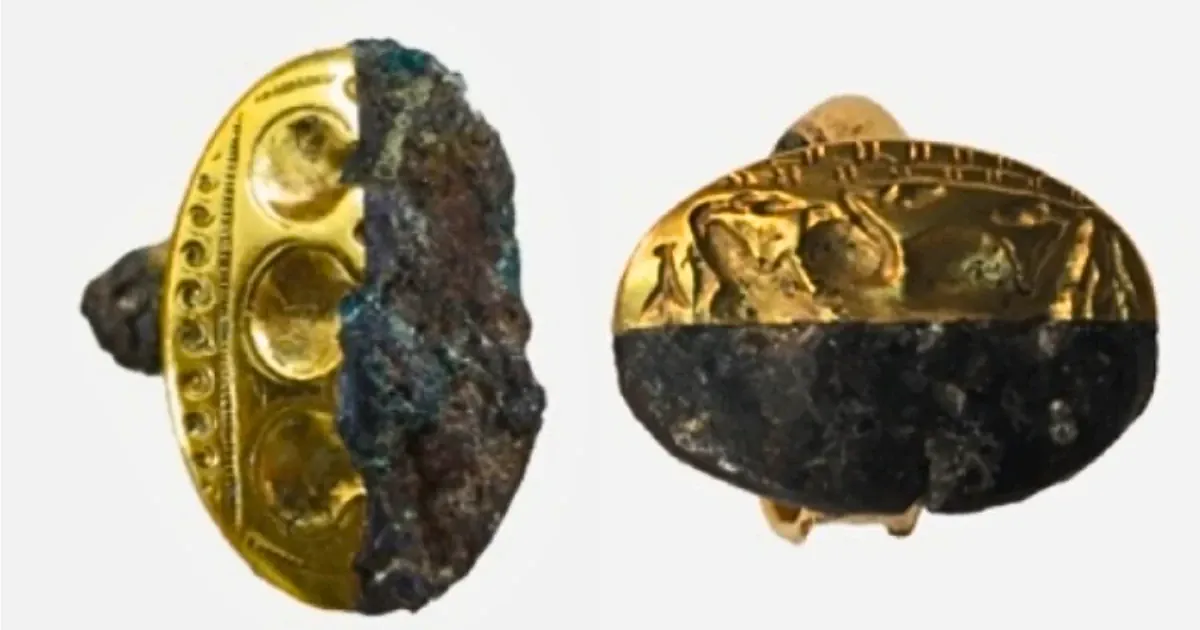
Rings with meteorite iron. Photo: Gounelle & Mantzourani, J. Archaeol. Sci. , 2026
Elite members of the Minoan and Mycenaean civilizations during the Bronze Age might have adorned themselves with rings fashioned from iron of meteoritic origin. A recent examination of artifacts from present-day Greece suggests that this unusual metal was utilized in the creation of opulent jewelry, possibly signifying status and authority.
This finding was reported by Science Alert.
Over a five-year research period, scientists conducted a chemical analysis of more than 100 archaeological finds unearthed in modern-day Greece. The majority of this sample consisted of 91 iron objects dating back to the Bronze Age, approximately 3,000 to 3,800 years ago.
Among the analyzed artifacts were items such as rings, bracelets, knives, and other implements. To ascertain the metal’s composition, specialists employed non-destructive X-ray fluorescence analysis, enabling the examination of the finds without causing any damage.
Consequently, the researchers detected nickel in 13 of the artifacts. Based on the study’s authors’ conclusions, these objects were likely manufactured from iron derived from meteorites.
The researchers paid particular attention to the fact that all 13 items with probable meteoritic iron were rings. Some of these pieces also incorporated precious metals, including gold and silver. The rings featured settings where seals could have been affixed. Furthermore, most of these particular items originated from affluent burials, notably tombs in Mycenae. Another ring was discovered by archaeologists in a Minoan necropolis, found still on the finger of a buried individual identified as a likely high priest.
According to the study’s authors, these meteorite iron rings could have been common accoutrements for influential figures within the Minoan and Mycenaean palace elite.
It is also proposed that the iron used for their creation might have been imported into Greece from Egypt. Due to Greece’s geography, meteorites there might have disintegrated or landed in the sea. In contrast, the arid climate of Egypt’s deserts would have aided in their preservation.
The research also indicated that an additional 78 analyzed iron artifacts were made from smelted, rather than meteoritic, metal. Such items may have appeared in Greece around 1400 BCE, although only two finds—a pendant and a ring—are dated before 1200 BCE.
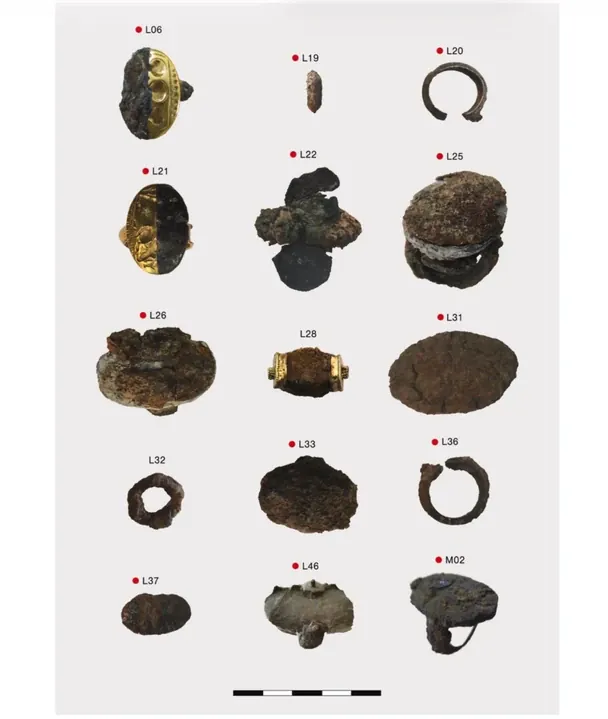
Objects analyzed during the study. Artifacts likely containing meteoritic iron are marked with red dots. Photo: Gounelle & Mantzourani, J. Archaeol. Sci., 2026
Scientists speculate that the use of smelted iron in Greece began later than in Anatolia. It is also possible that some early iron objects were imported, perhaps from Cyprus.
The trend of wearing rings made from meteoritic iron, according to researchers’ estimates, persisted until approximately 1200 BCE. The reasons for the subsequent disappearance of such jewelry are not precisely known. Possible causes cited by the scientists include shifts in material availability and changes in demand.
It is noted that the use of meteoritic iron in antiquity was not exclusive to the Mediterranean region. Across various parts of the world, it was employed to craft tools, weapons, jewelry, and other items. Notable findings include artifacts from Greenland, China, pre-Columbian America, and Egypt. One of the most famous examples is the dagger belonging to the Egyptian pharaoh Tutankhamun.
Previously, we reported that 22 stone blocks, weighing up to 80 tons, were recovered from the seabed off the coast of Alexandria. Researchers believe these might have been parts of the legendary Lighthouse of Alexandria.
Comments Sort: New Old Popular Send