

Fossilized jaws have provided scientists with new insights into giant octopuses that inhabited the Earth approximately 100 million years ago. Researchers estimate some of these creatures may have reached lengths of 19 meters, potentially being among the apex predators of ancient oceans.
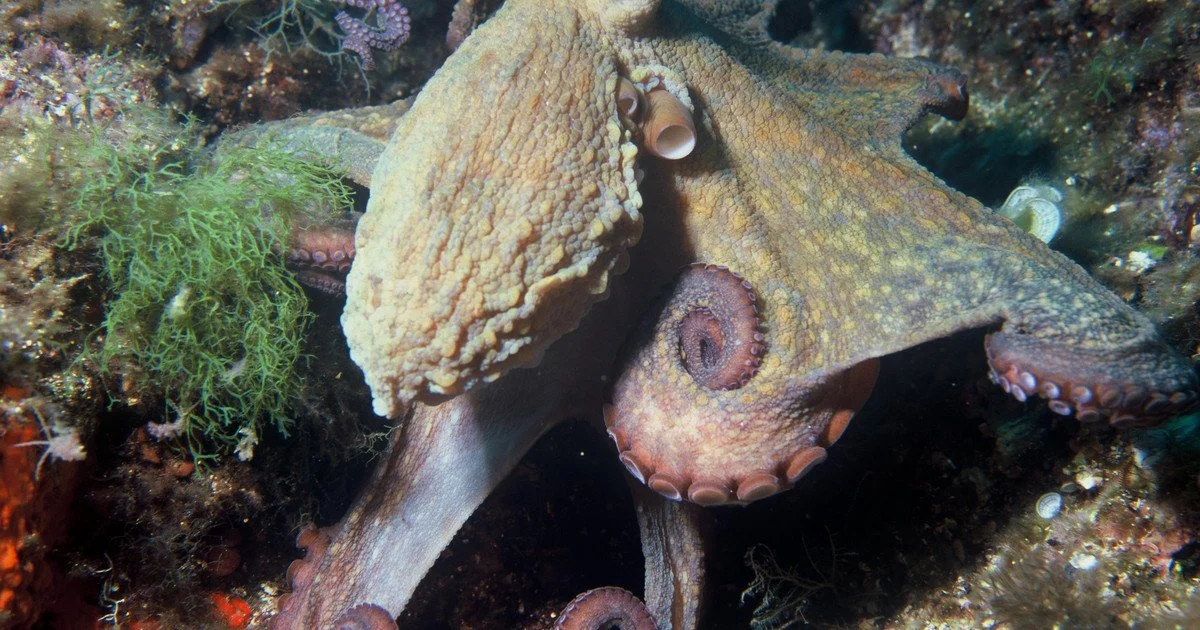
Octopus. Photo: Albert Kok
Fossilized jaws discovered within Cretaceous rock formations indicate the possible existence of colossal octopuses in the oceans around 100 million years ago, significantly surpassing the size of their modern relatives. Scientists hypothesize they were active hunters and likely occupied a high trophic level in ancient marine food webs.
This was reported by Space Daily.
The study’s authors highlight that octopuses are creatures that rarely leave fossil evidence behind. This is due to their bodies being composed primarily of soft tissues, lacking bones or shells that could preserve for millions of years. Therefore, the discovery of chitinous beaks, or jaws, has become a crucial source of information about prehistoric cephalopods.
A research team led by Shin Ikegami from Hokkaido University, in collaboration with colleagues from Japan and Germany, analyzed 27 fossilized jaws originating from late Cretaceous deposits in Japan and Vancouver Island. While fifteen of these were previously known, the scientists re-evaluated their classification. An additional 12 jaws were identified within rock matrices using high-resolution digital tomography, avoiding mechanical excavation.
According to the research findings, the fossils belong to finned octopuses of the genus Nanaimoteuthis, which lived approximately between 100 and 72 million years ago. The scientists estimate that the species Nanaimoteuthis jeletzkyi could have ranged from 3 to 8 meters in length, whereas the largest representative, Nanaimoteuthis haggarti, might have grown to around 7–19 meters. Even the lower end of this estimation exceeds the dimensions of any currently known confirmed octopus species.
The researchers paid close attention to the condition of the fossilized beaks, noting characteristic wear patterns such as chips, dulling, and uneven abrasion. The study’s authors suggest that such damage could have resulted from habitually crushing hard prey. Drawing parallels with modern octopuses, this implies that these ancient cephalopods may have used their beaks to break down shells or other tough exoskeletons.
In the researchers’ view, these characteristics suggest that the large Nanaimoteuthis were formidable marine predators and could have competed for ecological niches with large vertebrate inhabitants of Cretaceous seas. However, the authors emphasize that this does not constitute direct proof of them preying on large marine reptiles.
Scientists also point out that the estimations of body length are not derived from complete fossil remains but rather from the proportional relationship between beak size and body size observed in contemporary octopuses. Consequently, the maximum estimate of 19 meters represents a modeled calculation rather than a direct measurement. Nevertheless, even the most conservative estimates indicate that these animals were considerably larger than any modern octopus.
The work’s authors believe that this discovery offers a fresh perspective on Cretaceous period ecosystems. Given that soft-bodied organisms rarely preserve in the fossil record, their role in ancient oceans might have been significantly underestimated. The new findings suggest that alongside sharks and marine reptiles, giant finned octopuses could also have been significant predators.
Recall that during an exploration of the Pacific Ocean at a depth of approximately 6,200 meters, scientists encountered mysterious black cocoons. Analysis revealed that they contained a species of flatworm previously unknown to science.
Comments Sort: New Old Popular Send