

Astronomers have examined a popular theory concerning two planets that might have vanished from the Solar System billions of years ago.
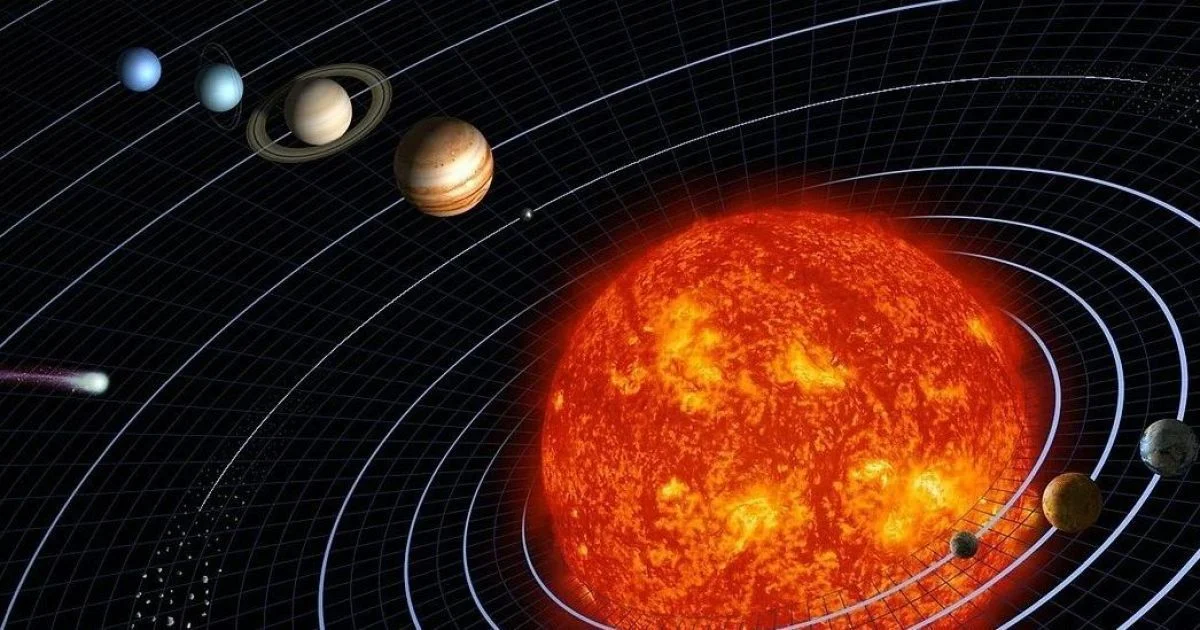
Solar system / © pixabay.com
In the early Solar System, there might have been ten planets instead of eight. This is the conclusion supported by proponents of the Nice model, which suggests that two ice giants were ejected from the system billions of years ago. However, a new study has cast doubt on this hypothesis, revealing discrepancies between theoretical calculations and the current state of Uranus’s moons.
This was reported by Science Alert.
Scientists have tested the so-called Nice model, a theory that describes a turbulent period in the Solar System’s history. It proposes that billions of years ago, the giant planets were in different positions and gradually altered their orbits. Modern versions of this model also consider the possibility that one or even two additional ice giants once existed in the Solar System, subsequently being expelled from its boundaries.
According to this hypothesis, the outer reaches of the Solar System underwent a period of significant instability. Gravitational interactions between planets could have altered their trajectories and influenced surrounding bodies. These very processes, proponents of the model believe, help explain the current arrangement of planets, the characteristics of the so-called Late Heavy Bombardment, and the large number of Trojan asteroids near Jupiter.
To verify how well this scenario aligns with other features of the Solar System, a team led by astrophysicist Matthew Clement from Johns Hopkins University conducted a series of computer simulations. The researchers modeled scenarios with one and two additional ice giants, tracking how potential planetary close encounters would affect the moons of Jupiter and Uranus.
The results indicated that in most cases, Uranus’s moons experienced severe orbital disturbances. In the simulations, this frequently led to collisions between moons, their ejection from orbit, or significant positional changes. Meanwhile, Jupiter’s moons proved considerably more resilient to such events.
According to the study’s authors, finding a scenario where the moon systems of both planets remained largely undisturbed proved extremely difficult. Only one developmental path consistently allowed for the preservation of the current structure of Jupiter’s and Uranus’s moons.
The researchers suggest this could point to several possible explanations. One is that the Solar System followed an extremely improbable evolutionary path, during which Uranus avoided the most destructive consequences of gravitational encounters. Another possibility is that Uranus’s moon system might have formed or reformed after this period of instability.
The authors also do not rule out the possibility that the current version of the Nice model is incomplete. They emphasize that no existing model can yet perfectly replicate all the characteristics of the Solar System, which formed over 4 billion years ago.
Scientists believe the new findings should spur further research.
Previously, scientists simulated one of the possible scenarios for the end of the Universe. The hypothesis suggests that our Universe is currently in a metastable (conditionally stable) state, which could suddenly collapse.
Comments Sort: New Old Popular Send